
For trades & home services
Web design for trades that need more than a digital business card.
A trade website has one job: turn someone who is worried about a job in their house into someone who asks you to quote for it. Everything else — the layout, the photos, the search structure — exists to serve that.
Built by people who understand service businesses
We've run service businesses, so we know the website is only part of it.
Between us we've built and grown service businesses of our own — quoting, chasing, turning up, sorting the ones that go wrong. We're not tradespeople and we won't pretend to be, but we've lived the commercial side: quote enquiries that go quiet, domestic work versus commercial work, service areas that stretch further than they should, competitors with more reviews, and the missed call at 4pm that becomes somebody else's job by teatime.
That's why we start with how work actually reaches you, then design the website around it. Phone, WhatsApp, form, referral, Google — each one needs somewhere sensible to land. Lead quality matters more than traffic: five enquiries for the work you want beats fifty for jobs you'd turn down.
The aim is better jobs, not busier stats.
Five questions, fast
A customer decides in about twenty seconds.
If your site answers these five things before they scroll twice, you're on the shortlist. If it doesn't, they're back on Google.
- 01
What do you do?
Named services, in the words customers use — not "solutions".
- 02
Where do you work?
Real coverage, stated plainly, so nobody wastes a call.
- 03
Can I trust you?
Reviews, accreditations, insurance, guarantees, a real name and face.
- 04
Can I see your work?
Job photos and finished projects, not stock images of a spirit level.
- 05
How do I get a quote?
One tap. Call, WhatsApp or a short form that asks four things, not fourteen.
The essentials
What a good trades website actually needs.
A page per service, not one long list
Someone searching for "exterior painting" should land on a page about exterior painting. A single services page asks Google — and the customer — to do the sorting.
Service areas you actually cover
Structured around the towns and postcodes you genuinely work in, with sensible depth. Not eighty near-identical town pages that read like a phone book.
Job pages that prove the standard
A handful of real jobs written up properly — the problem, what you did, the finish. This is the closest thing to letting someone walk round a completed job.
Reviews where they matter
Pulled onto the pages where people hesitate: pricing, larger jobs, commercial work. Genuine reviews only, always.
Your own photography
Phone photos taken on site beat stock every time. We'll tell you which shots are worth taking and crop and compress them so pages stay fast.
Accreditations and cover
Trade bodies, certifications, insurance and guarantees, shown where they answer a worry rather than buried on an About page.
Enquiries designed for one hand
Tap-to-call, WhatsApp where you'll actually answer it, and a quote form that captures job type, location and photos.
Fast on a building-site signal
Lean pages and compressed images, because half your visitors are on 4G in a van with one bar.
Own your visibility
Stop renting all of your visibility.
Directories, lead platforms, recommendation sites and social pages can all bring genuine work, and plenty of good businesses use them well. We're not going to tell you to switch them off.
The catch is that you rent that visibility. The price can change, the rules can change, your listing sits next to three competitors, and the enquiry belongs to the platform before it belongs to you.
A website you own, with search visibility you've earned and reviews attached to your own profile, is an asset. Build it alongside the rented channels, then decide how much you still want to rent.
Case study
Four Oaks Decorating
A painting and decorating business whose reputation locally was already strong — the website needed to carry the same weight for people who hadn't been recommended yet.
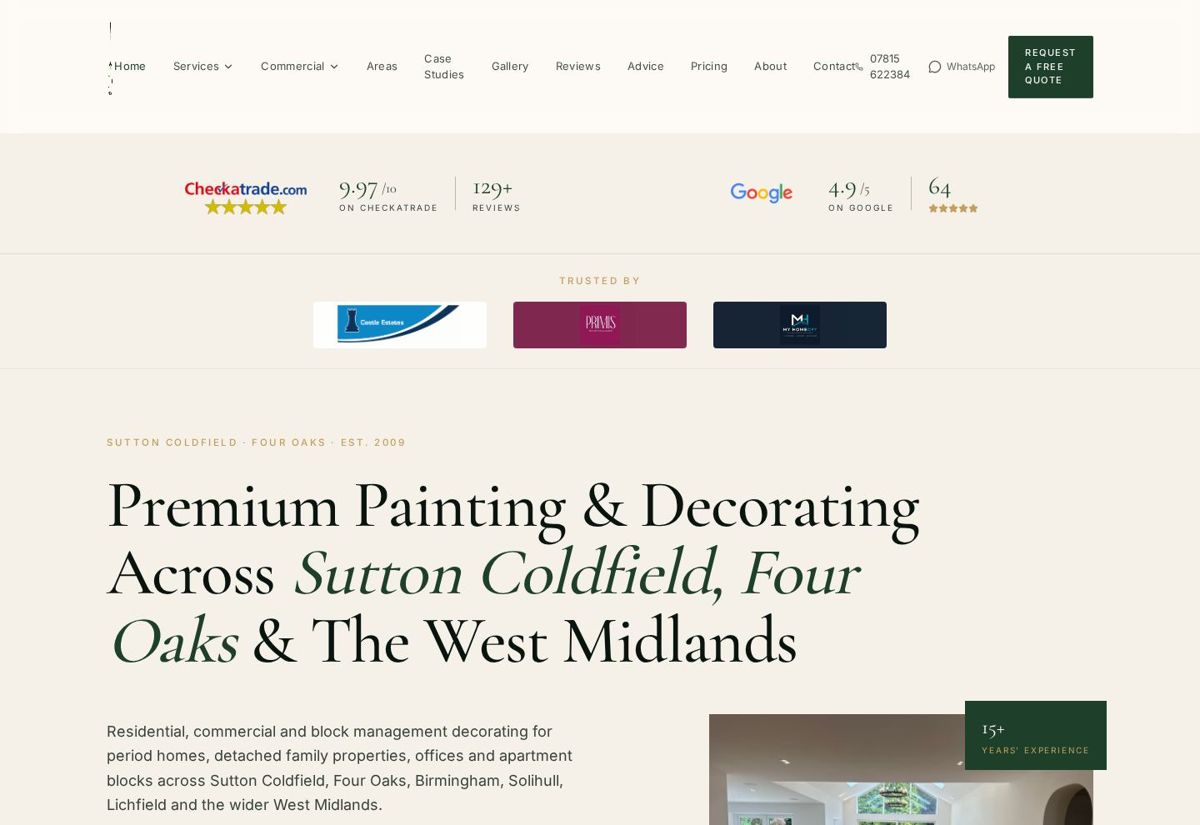
The thinking was straightforward. Split the work into the services people actually search for rather than one "decorating" page. Give the areas covered a real structure so an enquiry from a neighbouring town doesn't look like a stretch. Write up completed jobs so the standard of finish is visible instead of claimed.
Reviews sit where they answer hesitation. Commercial credibility — the fact that this is a run business, not a bloke with a brush — comes through in tone and presentation rather than in adjectives. The enquiry route asks for the job type, the location and a photo, which is what you need before quoting anyway.
Local search foundations were built in as the site was built: page structure, headings, internal links between services and areas, and accurate business information.
Another service business
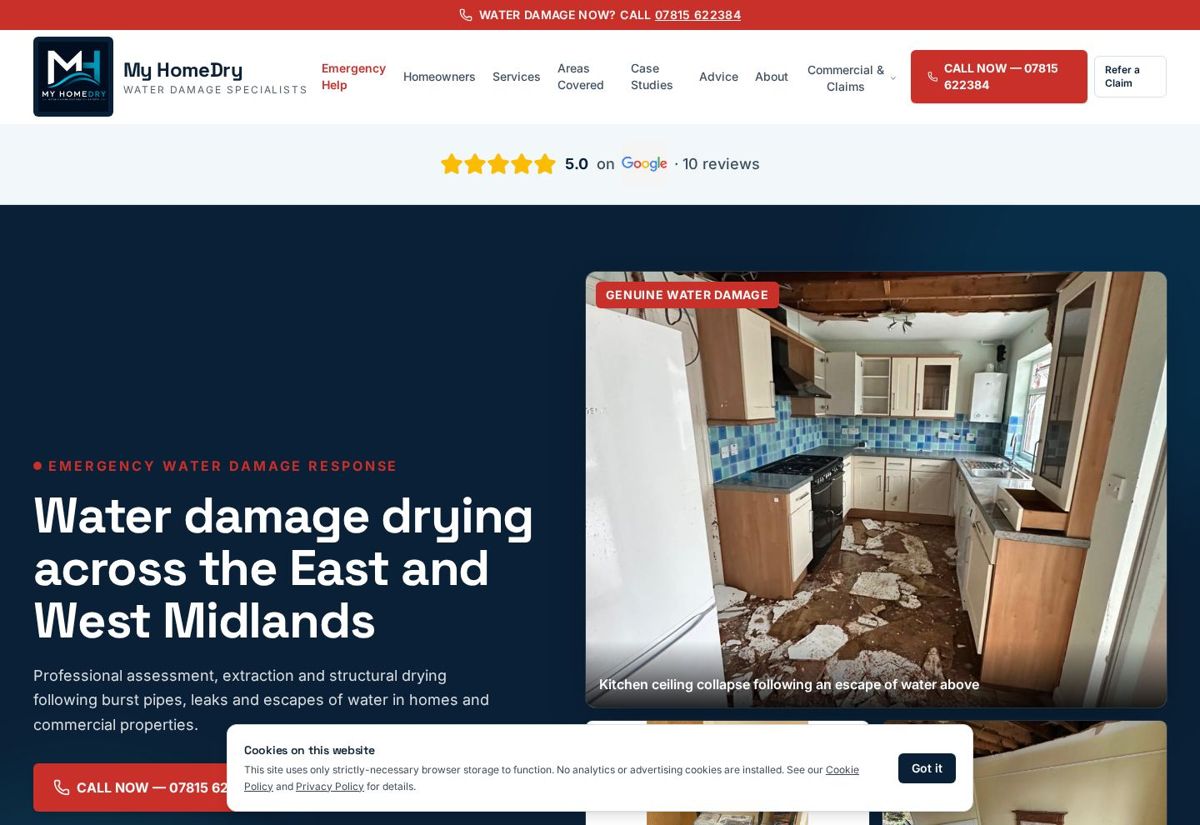
My HomeDry — when the job is technical and the customer is worried.
Damp, condensation and water damage are anxious purchases, often mid-emergency and usually compared across three companies at once. Trust has to land immediately, and technical credibility has to be obvious without turning the page into a lecture.
So the site explains the problem before it sells the service: separate pages for separate problems, plain-English explanations of causes and treatment, and a clear route to booking a survey. Emergency intent is treated differently from research intent — someone with water coming through a ceiling needs a phone number, not a brochure.
The service architecture is what makes the search visibility possible. Distinct problems, distinct pages, genuine coverage areas.
Who this suits
Trades and service businesses we can work with.
Not on the list? The thinking usually travels — if you quote for work in people's homes or premises, we can help.
- Painters and decorators
- Builders
- Carpenters and joiners
- Electricians
- Plumbers and heating engineers
- Roofers
- Landscapers and groundworks
- Property maintenance companies
- Flooring businesses
- Kitchen and bathroom fitters
- Blinds and window furnishings
- Cleaning businesses
- Damp and water-damage specialists
- Other local home-service businesses
Website + SEO
A website that exists, versus a website that brings work.
Building the site is a project with an end date. Becoming a source of organic enquiries is a habit: watching what people actually search, adding the pages that are missing, writing up new jobs, keeping the profile and reviews moving.
Some trades only need the first part — the referrals are there, the site just needs to close them. Others want search to replace paid leads, and that needs ongoing work. We'll tell you which camp you're in.
Start with local SEO if you work in defined areas, or the broader SEO service if you're competing further afield.
Pricing
Fixed prices, published.
Launch
£1,000
A focused site: services, areas, proof, quote route.
Growth
£3,000
Service pages, project write-ups and search foundations working properly.
Scale
£5,000
Larger operations — domestic and commercial, multiple locations or teams.
By trade
Pages written for your trade, not trades in general.
The structure changes depending on what you quote for. These go into the detail — and the full list of sectors sits on the industries page.
Painters & decorators
Separate domestic, exterior and commercial journeys, with finished-work photography doing the selling.
Builders
Five-figure projects, researched carefully — detailed project stories and a visible process.
Plumbers & heating
Emergency callouts and planned bathrooms are two different visitors on one website.
Electricians
Domestic callouts and commercial testing contracts, kept clearly apart.
Roofers
Where legitimacy is the objection and proof has to land in seconds.
Landscapers
Before-and-after transformations that move you from tidy-ups to full projects.
Trades questions
The questions we get asked on site visits.
Thinking about a rebuild rather than a first site? Start with website redesign. Already getting work from a directory? Read trade directories versus your own website. For the search side of things, see SEO for trades.
Next step
Got a vision?
Let's build the venture.
Tell us what your business does and what you need the website to achieve. We'll come back to you personally with honest thoughts — and a clear proposal if it's a good fit.