
For sports & 1-2-1 coaches
Web design for coaches that turns expertise into something people can understand and buy.
Coaching is a personal service sold in advance of anyone meeting you. The website's job is to answer who you are, what's actually running, and how to get a place — before the enquiry turns into a scroll back to Google.
People buy the coach
Coaching is trust, sold before the first session happens.
A parent handing over a child, or an adult committing to weekly sessions, is trusting a named person. The site has to carry that trust honestly — nothing invented, nothing implied that isn't true.
The coach, not just the club
Parents and adult clients are booking a person before they're booking a programme. A name, a face, a short account of experience and coaching style does more work than a logo ever will.
Genuine testimonials, supplied by you
We'll ask for quotes you've actually received — a WhatsApp message, an end-of-term comment, a parent's email. We never write these for you and never imply a qualification, badge or governing-body status you haven't given us in writing.
Outcomes described honestly
Improved confidence, better ball control, a child who now looks forward to Tuesdays — described plainly, not dressed up as guaranteed results.
Session information that answers the practical questions
Venue, day, time, age group and what to bring, stated on the page rather than left for a message exchange.
Case study
Archer Football Coaching
Sessions, camps and one-to-one coaching were being filled through word of mouth and social posts that disappeared within a day, with no permanent place for parents to check what was running.
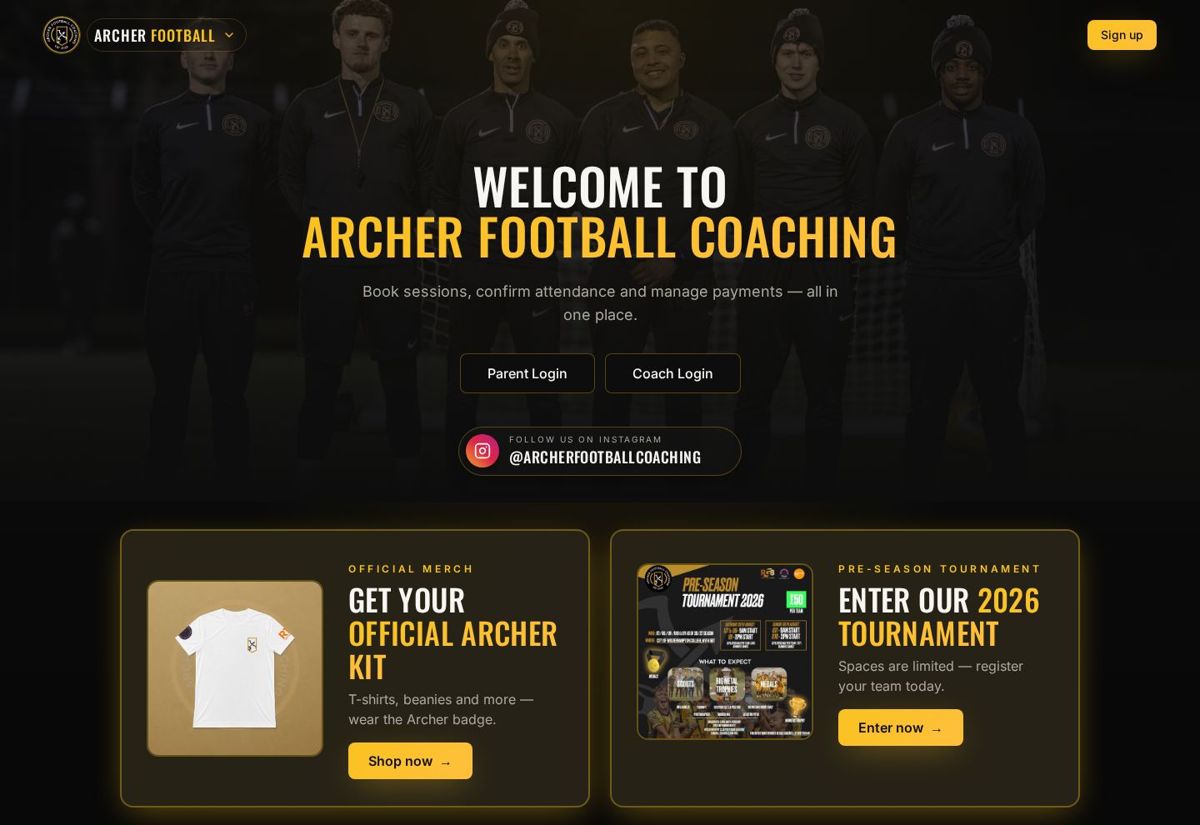
The rebuild gave sessions, camps and one-to-one training their own pages, each with age groups and venues stated plainly, rather than one blended timetable that only made sense to people already familiar with it.
A registration flow suited to parents booking on behalf of a child replaced the previous back-and-forth over social media, and the structure was built so seasonal holiday camps can be added without rebuilding the site each time.
Structuring the offer
One-to-one and group coaching need very different pages.
They're sold differently, priced differently and booked differently — treating them as one offer is where most coaching sites lose clarity.
One-to-one coaching
Priced per session or per block, with what a session actually covers — duration, location, whether it's indoor or outdoor, and whether equipment is provided. Blocks need an end date and a clear renewal step, not an open-ended arrangement nobody remembers agreeing to.
Group programmes and terms
Structured around term dates, not vague ongoing availability. State capacity per group, current spaces, and what happens once a group is full — a waiting list people can actually join, not a message to 'check back'.
Holiday camps and one-off sessions
Kept separate from term-time programmes so a parent looking for a single half-term camp isn't wading through a season's worth of weekly sessions to find it.
Price signals, even where prices vary
If pricing depends on group size or venue, say so and give a realistic range. 'Contact for pricing' on every single offer reads as a business hiding something, even when it isn't.
How enquiries actually arrive
Word of mouth still starts most of it. Search finishes the job.
Most coaching enquiries begin as a recommendation from another parent, a post in a school or parents' Facebook group, or a share on Instagram. What happens next decides whether it turns into a booking: someone checks you online before messaging.
Alongside that, people search directly — often for something very specific.
- Sport or discipline plus location — "football coaching Sutton Coldfield", "tennis coach Birmingham".
- Age group specific searches — "under 8s football training near me", "coaching for teenagers".
- Direct one-to-one intent — "1-2-1 coaching near me", "private football coach".
- Named programmes once they're established — parents searching the camp or club name directly after a recommendation.
A site with no session times, no price signal and DM-only booking loses that search enquiry the moment it lands, regardless of how good the coaching is.
Where coaching sites lose bookings
The mistakes we see most often.
- 01
Every session, camp and price crammed onto one page, so nobody can tell what's currently running.
- 02
No listed times or days, so the only way to check availability is to ask.
- 03
No price signal anywhere, which filters out families who'd have booked if they'd known the range.
- 04
Booking only through Instagram DMs, which loses enquiries the moment the coach is mid-session or offline.
- 05
No waiting list, so a full group just looks closed rather than in demand.
Coaching for children
If most of your clients are booking on behalf of a child, that changes the brief.
Coaching aimed at children shares a lot with other children's businesses — the person enquiring isn't the person taking part, safety and reassurance carry more weight, and the language on the page needs to speak to a parent, not a peer.
We cover that ground in more detail on our page for web design for children's businesses, which is worth reading alongside this one if children make up most of your client base.
Pricing for a coaching website follows the same structure as everywhere else: Launch at £1,000 plus £49/month for hosting and care, Growth at £3,000, Scale at £5,000, or a custom quote for something larger — set out in full on our pricing page. If you'd like the broader view of how we approach different sectors, see industries we work with, and if yours is closer to a general small business than a coaching practice, our web design for small business page may be the better starting point.
Before you ask
Coaching website questions
Next step
Got a programme worth booking?
Let's give it a proper home.
Tell us what your business does and what you need the website to achieve. We'll come back to you personally with honest thoughts — and a clear proposal if it's a good fit.