
For tutors & education businesses
Web design for education businesses where parents need confidence before they enquire.
A parent choosing a tutor is weighing up a stranger teaching their child. The website has to remove doubt before the first message — who you teach, what you cover, how a session works, and what happens next.
Before a parent will enquire
Six things a parent needs to understand first.
None of this is complicated to provide. It's usually just missing, which leaves a parent to ask by message what the site should already have told them.
Who is this for
A parent scanning a tutoring site wants to know within seconds whether it's aimed at their child — primary, secondary, GCSE, A-level, or adult learners. Say it directly rather than leaving it to be inferred.
Subjects and key stages
Named subjects mapped to key stages, not a single vague 'academic tutoring' line. A parent of a Year 9 needing science support is looking for something specific.
Teaching approach
How a session actually runs — one-to-one or small group, a set curriculum or tailored to the child, homework and progress updates. This is what separates one tutor from the next in a parent's mind.
Online versus in-person
Stated per subject or programme if it varies, with what's needed for online sessions (platform, materials) explained plainly.
Trust and safeguarding, evidenced honestly
We present only what a business can evidence — DBS status, insurance, experience — in the tutor's own words and documentation. We never draft or imply a regulatory or accreditation claim on a client's behalf.
How to enquire
A form that asks for the child's year group, subject and rough availability, so the first reply back can be useful rather than a round of basic questions.
Case study
Learning Loft
Parents were arriving with the same questions every time — which subjects, which year groups, online or in person, how much — and the previous site answered none of it quickly, so every enquiry started from zero.
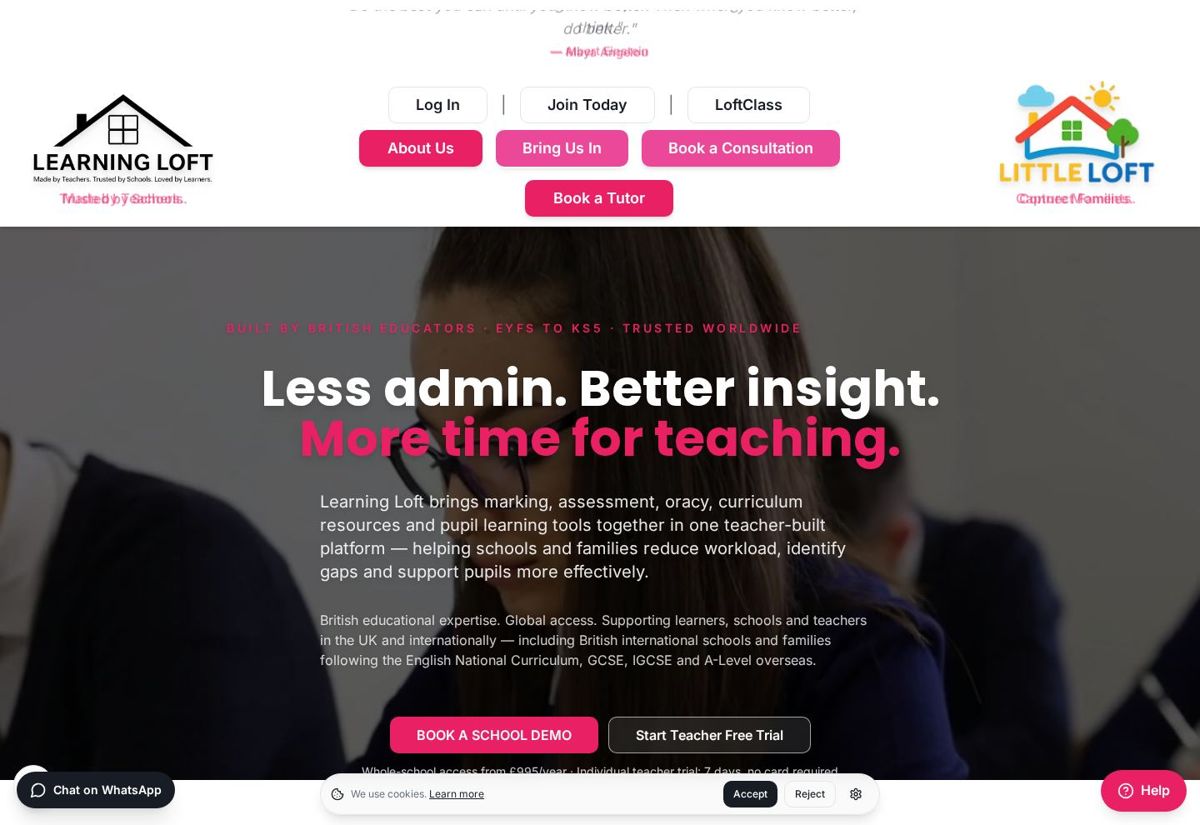
Rebuilding the site around subject and key-stage pages meant a parent could reach a clear answer within one screen instead of a phone call. Each core subject got its own page rather than sharing space on a single crowded list.
The enquiry flow now captures the child's year group and subject up front, so the first reply from Learning Loft can be specific and useful rather than a round of clarifying questions.
The academic-year rhythm
Tutoring enquiries follow the school calendar, not the sales calendar.
September
The single busiest enquiry period, driven by a new school year and parents deciding early whether extra support is needed. A site that isn't ready by late August misses the peak.
Exam season
January to May brings a sharp rise in GCSE and A-level enquiries, often urgent and comparing several tutors within days. Clear exam-board information and fast response matter more than usual here.
Transfer and entrance exams
11+ and other entrance-exam preparation runs on its own calendar, often starting a year or more ahead. Where this is part of the offer it needs its own clearly dated section, not a line buried in general tutoring copy.
How parents actually search
Specific, local, and often exam-board specific.
A parent rarely searches for "tutoring" alone. The phrase usually already contains the subject, the level and the town.
- Subject plus key stage plus town — "GCSE maths tutor Sutton Coldfield".
- Direct near-me searches — "maths tutor near me", "English tutor near me".
- Exam board specific searches — "AQA GCSE science tutor", "Edexcel maths tuition".
- Entrance exam searches around 11+ and grammar school admissions, usually well ahead of the exam date.
Where tutoring sites lose enquiries
Four commercial mistakes we see repeatedly.
- 01
No prices anywhere, leaving cost as the one thing a parent has to message to find out.
- 02
No year groups stated, so it's unclear whether the tutor covers primary, GCSE, A-level or all three.
- 03
No explanation of session format, leaving online-versus-in-person and group-versus-one-to-one unanswered.
- 04
Enquiry forms that ask for a name and a message and nothing else, giving the tutor no useful information to reply with.
Teaching children specifically
If your learners are mostly children, that shapes more than the copy.
Education businesses working with children share concerns with other children's services — the parent enquiring isn't the person in the room, and reassurance about safety and suitability carries real weight in the decision.
We go into that in more depth on web design for children's businesses, worth a read alongside this page if your client base is largely under-18s.
Where local visibility matters as much as the site itself, our local SEO approach covers how subject-and-area structure and an accurate Google Business Profile work together. Pricing runs Launch at £1,000 plus £49/month hosting and care, Growth at £3,000, Scale at £5,000, or a custom quote for something larger, detailed on our pricing page. For the wider picture of sectors we work across, see industries, or if your business is closer to a general small business than an education specialism, start with web design for small business.
Before you ask
Tutoring website questions
Next step
Ready for parents to trust the site as much as they'll trust you?
Let's build it properly.
Tell us what your business does and what you need the website to achieve. We'll come back to you personally with honest thoughts — and a clear proposal if it's a good fit.