
For home improvement businesses
Web design for home-improvement businesses selling considered purchases.
A new kitchen, a set of shutters or a re-carpeted house isn't an impulse buy. Customers research first — and the website's job is to help them understand the options, see real examples, compare what's on offer, build confidence in your work, and request a quote without a showroom visit they haven't decided to make yet.
A considered purchase, not a quick sale
Customers are shortlisting before they ever get in touch.
This applies whether the business fits blinds, shutters, windows, kitchens, bathrooms, flooring, fitted furniture, or handles decorating and other improvement work — the pattern is the same. It's your home-improvement business we're describing here; we're not claiming to have worked across every one of those sectors, but the thinking travels because the buying behaviour does.
A visitor arrives with a room in mind, not a product name. They want to see what's possible, get a rough sense of cost, and understand what happens between saying "yes" and having it fitted. If the site can't answer that quickly, they move to the next tab.
How the decision actually happens
What's going through a customer's head before they enquire.
They compare before they call
Someone replacing a bathroom or fitting shutters throughout a house is rarely ready to buy on the first visit. They're looking at three or four companies, checking finishes, reading between the lines on price and deciding who to let into their home first.
They need the process spelled out
Measure, quote, order, lead time, fit — in that order, in plain terms. A customer who doesn't know whether fitting takes a week or six weeks will assume the worst and ask somewhere else.
They're judging price range before they ask
Nobody wants to request a quote only to discover the business is far outside their budget. Signals — finish level, materials, phrases like 'made to measure' or 'bespoke' — tell a visitor roughly where they sit before they pick up the phone.
They want to see it finished, not just supplied
A product photo on a white background answers 'what is it' but not 'will it suit my room'. The site has to show real installations, in real homes, so the customer can picture their own.
Case study
Royal Blinds
A made-to-measure blinds and shutters business with a wide product range that needed to be browsable by room, not just listed as a catalogue.
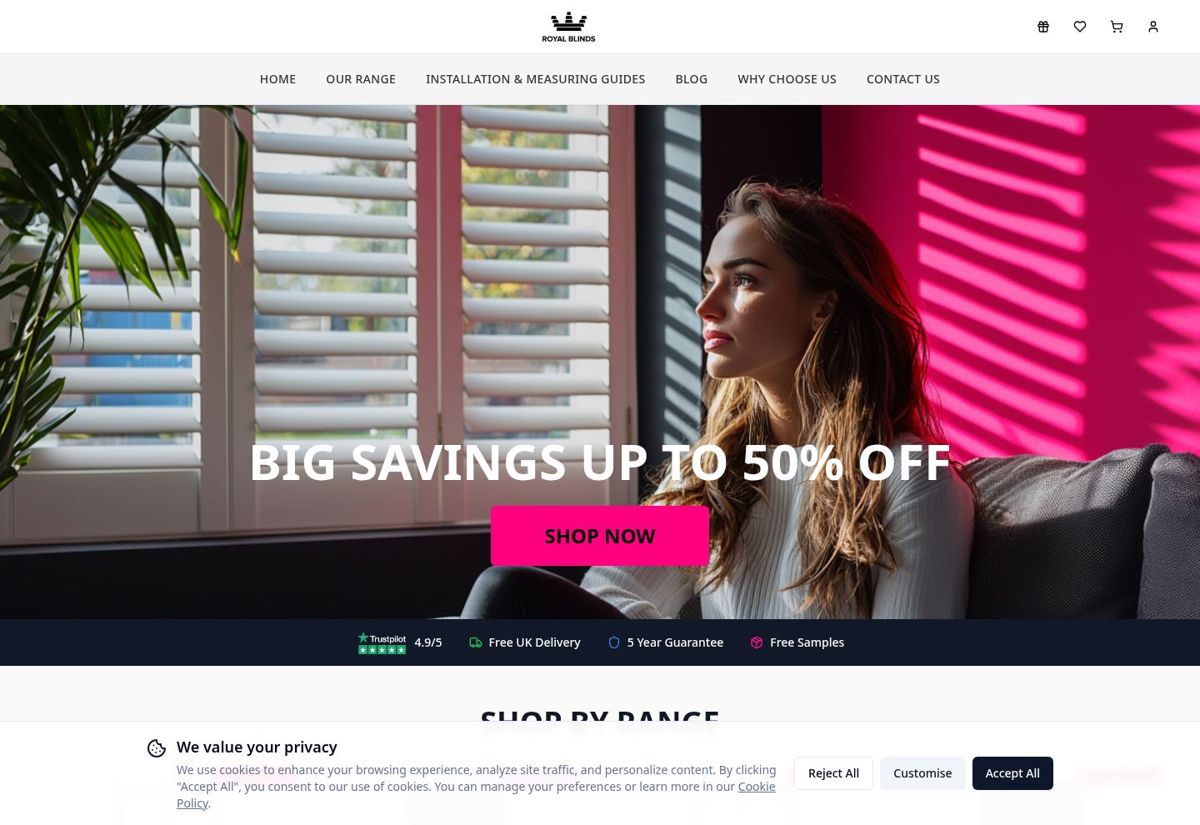
Customers were arriving knowing the room, not the product name — "something for a bay window" rather than "perfect-fit venetian". The site now lets people enter by room and by problem, then guides them into the right product type.
A free measure-and-quote booking flow sits at the end of every product page, built for someone browsing on the sofa rather than filling in a form at a desk. The structure was also built to take new product ranges without a redesign each time a new fabric or shutter style is added.
A related project
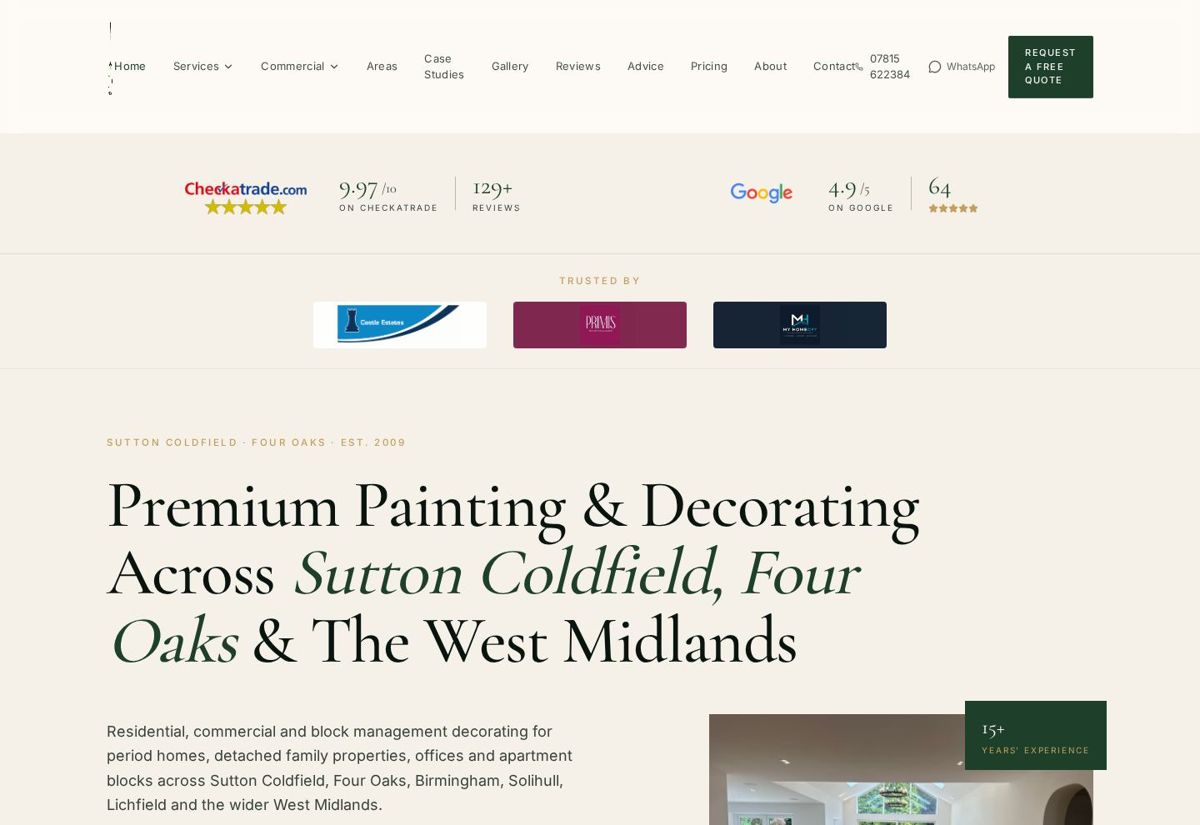
Four Oaks Decorating — the same principle, a different service
Decorating sits inside the same category: a considered purchase carried out inside someone's home, where trust and visible quality matter more than a price list. The site splits work by interior, exterior and commercial decorating, with a before-and-after gallery doing most of the persuading.
Read the Four Oaks Decorating case study or see the full web design for painters and decorators page.
Visual proof matters
People are buying a finished room, not a component.
A photo of a kitchen worktop or a roll of carpet doesn't sell the job — a finished kitchen or a finished floor, in someone's actual home, does. Galleries organised room-by-room, and case studies organised by product range, let a visitor find the example closest to their own situation instead of scrolling a mixed folder hoping to spot something similar.
This is also where a genuinely delivered project earns its keep twice: once as proof of quality, and again as a page that can rank for the exact search — "fitted wardrobes Sutton Coldfield", "bathroom renovation photos" — that brought the customer looking in the first place.
Service architecture
High-value services deserve their own page, not a shared shelf.
A single "products" or "services" page forces every visitor — and every search engine — to do the sorting themselves. Someone looking for shutters and someone looking for a full kitchen refit have almost nothing in common, and lumping them together weakens the page for both.
A dedicated page can carry the detail a considered purchase needs: the range, the price-range signal, the process specific to that service, and the photography that proves it. It can also be found for the exact thing it covers, instead of competing for attention on a page trying to be everything at once.
This matters most for showroom versus home-visit journeys — a blinds business might want people to book a showroom slot, while a kitchen fitter might want a home visit booked directly. Each service can be built around the journey that actually suits it.
Common mistakes
What loses the enquiry before it's made.
Product shots with no context
A roller blind on a plain background tells a customer nothing about how it looks against their own windows, walls or light. Every product deserves at least one in-situ photograph.
No mention of lead times
Home-improvement purchases usually have a deadline behind them — a new kitchen before Christmas, blinds before a house move. Leaving out lead times just means the customer asks a competitor first.
The buying process left unexplained
Measure, quote, order, fit sounds obvious to the business and is not obvious at all to a first-time customer. Skipping it leaves people guessing how many visits, how much notice, and how much upheaval to expect.
Sectors this suits
The thinking applies across a wide range of considered purchases.
- Blinds and shutters
- Windows and doors
- Kitchens
- Bathrooms
- Flooring
- Decorating
- Fitted furniture and wardrobes
- Other home-improvement services
We don't have genuine clients across every one of those — Royal Blinds and Four Oaks Decorating are the two above. If your sector isn't listed, the buying behaviour and site structure described here still apply; we'd rather say that plainly than imply experience we don't have. See how this fits into the wider web design for small business approach.
Home improvement questions
Common questions from home-improvement businesses
More on getting found locally is on the local SEO page, and full costs are on pricing. See how this sits alongside other sectors on industries.
Next step
Got a vision?
Let's build the venture.
Tell us what your business does and what you need the website to achieve. We'll come back to you personally with honest thoughts — and a clear proposal if it's a good fit.