
Trade lead generation
Want more trade enquiries? Start by working out where the good ones already come from.
SEO is one route to more work, not the only one. Before spending money on any of them, it's worth knowing which channels already bring you the jobs you actually want — and whether the problem is enquiry volume or what happens after someone enquires.
Where work actually comes from
Ten sources, none of them the whole answer on their own.
Most trade businesses get enquiries from several of these at once, usually without tracking which ones actually matter.
Recommendations
Usually the highest-quality lead a trade gets — someone's already vouched for you before the phone rings. Hardest to manufacture, easiest to lose track of.
Repeat customers
Cheaper to win back than to find new, and they already know what to expect. Worth actively staying in touch with, not just hoping they remember you next time.
Google organic search
Someone searching for what you do finding your website without an ad next to it. Builds slowly, keeps working without ongoing spend once it's there.
Google Maps / Google Business Profile
For businesses that serve customers locally or in person, often the first thing a searcher taps. Free, but only available if you genuinely operate where you claim to.
Directories
Checkatrade, Which? Trusted Traders and similar. Can bring steady enquiry volume, usually at a subscription cost, and you're competing on the same page as rivals.
Social media
Good for showing finished work and staying visible to people who already know you. Rarely a strong source of cold enquiries on its own for most trades.
Paid advertising
Google Ads or social ads can generate enquiries quickly, at a cost per lead that has to be watched closely. We don't run paid campaigns at Vision & Venture — we're upfront about that rather than pretending otherwise.
Partnerships and commercial relationships
Other trades, letting agents, builders' merchants, property managers. Slower to build, often produces the steadiest and best-fit work once established.
Signage and vans
Passive, cheap once bought, and surprisingly durable — a van seen daily on the same roads builds familiarity that shows up as enquiries months later.
Networking
Local trade groups, business networking events, trade associations. Works the same way partnerships do: slow to start, compounding once relationships exist.
Our position
More leads versus better leads.
It's tempting to treat "more enquiries" as the goal on its own. But every enquiry costs time — a call, a site visit, a quote — whether or not it turns into work you actually want. A flood of low-quality enquiries can leave a trade busier and worse off at the same time.
Quality means enquiries for the work you're best at, in the areas you cover well, from customers who are ready to book rather than collecting quotes. Getting more of those often matters more than getting more enquiries overall.
That's a genuine trade-off worth thinking through before spending money on any channel, including SEO.
Track the source
You can't fix what you haven't measured.
None of this needs software or a big process. It needs to actually happen, every time, for a few months.
- 01Ask on the phone or in person: "How did you hear about us?" — the simplest method, and often the most reliable if you actually log the answer.
- 02Add a "how did you hear about us" field to your enquiry form — not mandatory, but genuinely reviewed rather than ignored.
- 03Treat call tracking numbers as a useful extra signal, not gospel — they tell you which number was dialled, not always the full story of how someone found you first.
- 04Use Google Search Console to see what people actually searched before landing on your site — often different from what you assumed you ranked for.
- 05Use analytics to see which pages and channels enquiries came through, then look at the two together rather than either alone.
Before buying more traffic
Improve conversion first — it's usually cheaper.
If the same number of visitors converted into twice the enquiries, that's a better return than doubling traffic at the current rate. Look at these before spending more on any acquisition channel.
Reviews
Recent, detailed reviews reduce the hesitation that stops someone from picking up the phone in the first place.
Project proof
Photos of real completed work, ideally with a line of context, do more to convert a visitor than a page of adjectives.
Response speed
A quick reply — ideally the same day — often matters more than being the cheapest quote. Slow responses lose jobs that were never actually close.
A clear quote process
What happens after someone enquires, roughly how long a quote takes, whether there's a site visit. Uncertainty makes people go elsewhere.
A website that says what you do, plainly
Vague service descriptions leave a visitor guessing whether you cover their job at all. Being specific loses you nothing and gains clarity.
Clear coverage areas
Stated honestly. A visitor who can't tell if you cover their town won't ring to ask — they'll just try the next search result.
Build something you own
Directories are rented. Your own site is owned.
A directory listing or a social profile can bring work, but you're building on someone else's platform, under their rules and pricing. A website you own — with its own search visibility — keeps working on your terms, and it's the one channel that compounds rather than resets every renewal.
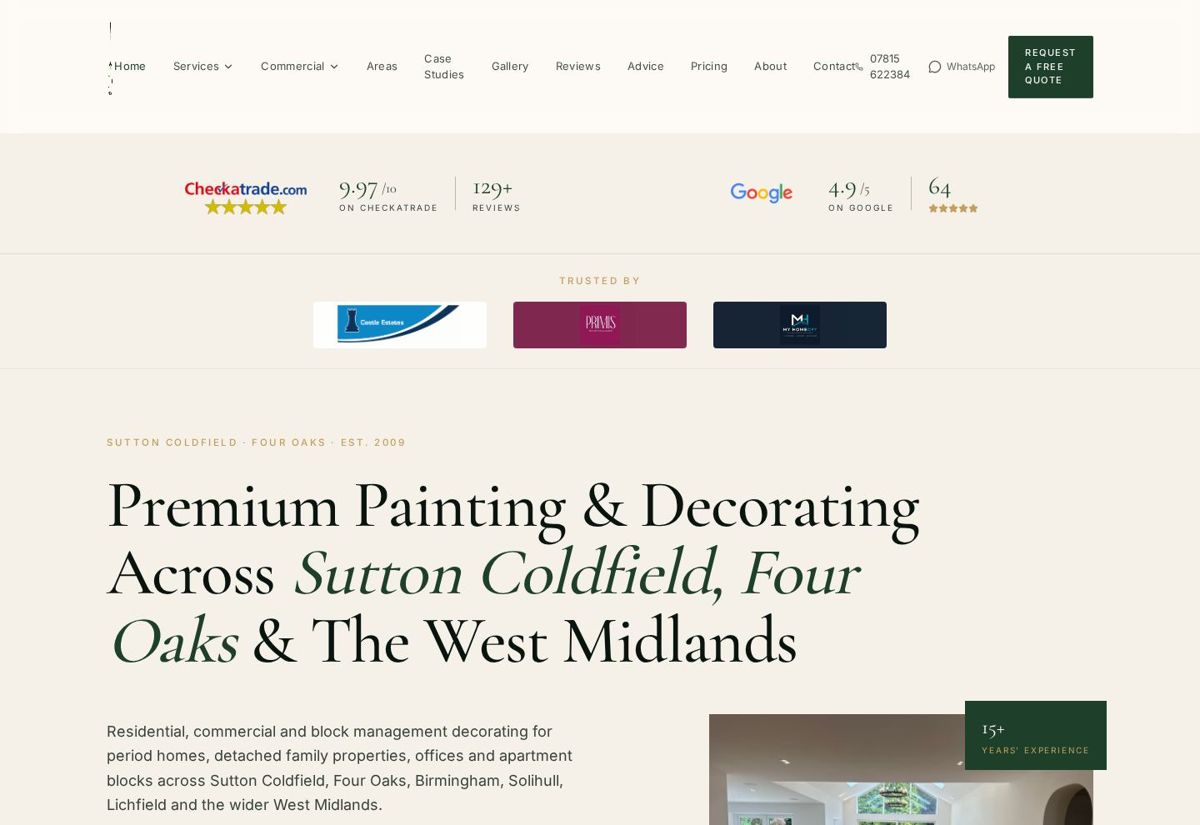
Four Oaks Decorating is a straightforward example: individual service pages, honest coverage areas and real completed jobs, all on a site the business controls outright. It's worth comparing that structure against a directory listing versus your own website.
Before you ask
Trade enquiry questions
Want the website itself doing more of the work? See web design for trades or how we approach SEO for trades.
Next step
Got a vision?
Let's build the venture.
Tell us what your business does and what you need the website to achieve. We'll come back to you personally with honest thoughts — and a clear proposal if it's a good fit.